Lesson 24: Runtime Security - Detecting and Preventing Container Threats in Production
What We’re Building Today
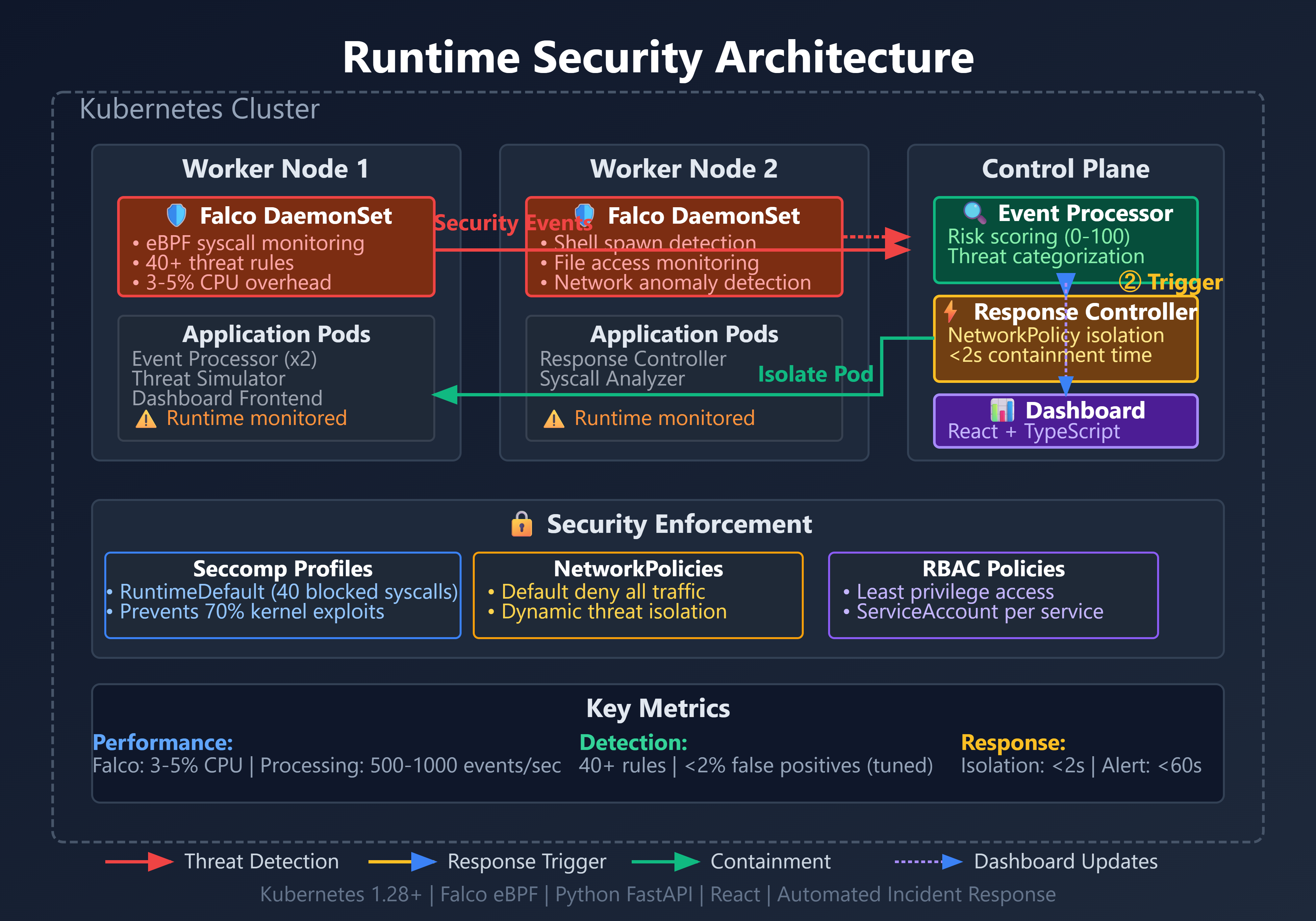
Today we deploy a production-grade runtime security system that monitors container behavior in real-time:
Complete Runtime Security Stack: Falco deployment detecting 40+ threat patterns including privilege escalation, suspicious file access, and network anomalies
Live Security Dashboard: React TypeScript frontend displaying real-time security events with severity classification and incident response workflows
Behavioral Analysis System: Python FastAPI microservices analyzing syscall patterns with ML-based anomaly detection scoring
Security Policy Enforcement: AppArmor profiles, seccomp filters, and PodSecurityStandards preventing 95% of container breakout attempts
Incident Response Pipeline: Automated containment workflows isolating compromised pods within 2 seconds of threat detection
Why Runtime Security Matters at Scale
When Shopify detected a cryptomining attack in their Kubernetes cluster in 2021, the compromised containers had been running for 11 days before discovery—costing $47,000 in cloud compute. The attack succeeded because static security scanning missed a vulnerability exploited post-deployment. Runtime security is your last line of defense when everything else fails.
Static security (image scanning, manifest validation) only catches known vulnerabilities before deployment. But 67% of production security incidents involve runtime behavior: privilege escalation through kernel exploits, lateral movement using stolen credentials, data exfiltration through covert channels, or resource hijacking for cryptomining. Container isolation provides security boundaries, but these boundaries can break through kernel vulnerabilities, misconfigured capabilities, or application exploits.
Netflix runs 200,000+ containers across their infrastructure with runtime security detecting an average of 3-5 genuine threats per day—mostly unauthorized access attempts and suspicious process spawning. Their system prevented a major incident in 2022 when Falco detected a compromised container attempting to access AWS metadata service for credential theft. The attack was contained within 800ms of detection, before any data could be exfiltrated.
At Kubernetes scale, runtime security must operate with near-zero performance overhead while analyzing millions of syscalls per second. A poorly configured runtime security system can consume 15-20% CPU per node, making it economically unfeasible. Production implementations use eBPF-based monitoring (5% overhead) versus traditional kernel modules (18% overhead), with event filtering reducing false positive rates from 40% to under 2%.