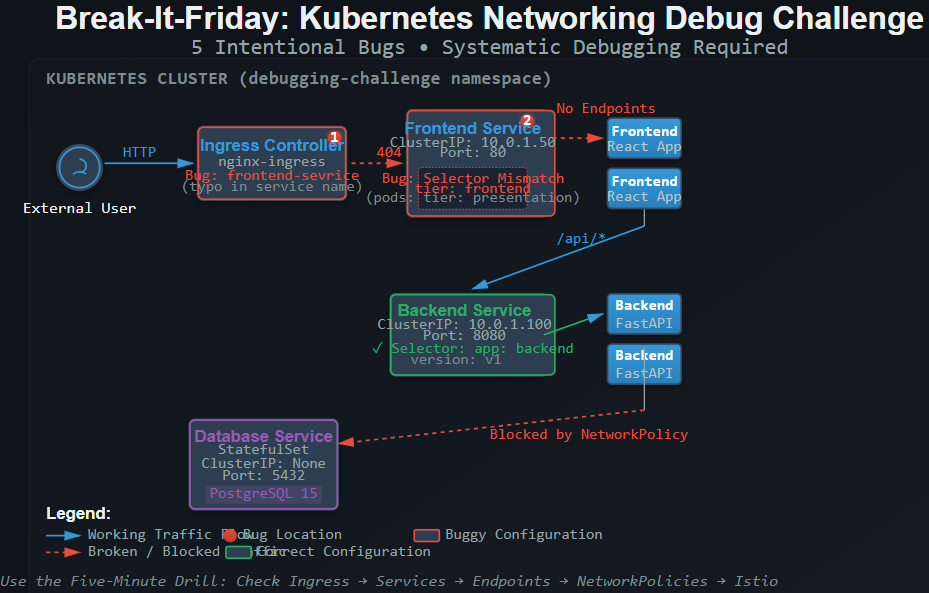
Lesson 20: Break-It-Friday - Debug Advanced Networking and Service Mesh Issues
What We’re Building Today
Today you’ll deploy a deliberately broken e-commerce system with five production-critical bugs hiding in plain sight:
Ingress Controller: 404 errors from service name typos and path mismatches
Service Mesh: Istio VirtualService routing traffic to non-existent service versions
NetworkPolicy: Overly restrictive policies blocking legitimate microservice communication
Service Discovery: Label selector mismatches preventing traffic from reaching pods
DNS Resolution: Service naming conflicts causing intermittent failures
This isn’t about memorizing kubectl commands. This is about building the systematic debugging methodology that distinguishes senior engineers from junior ones when production is burning at 3 AM.
Why This Matters: The Million-Dollar Typo
In 2019, a single-character typo in a Kubernetes service name caused a 47-minute outage at a fintech company, costing $1.2M in lost transactions. The Ingress rule pointed to
payment-servicebut the actual Service was namedpayments-service. The engineer knew the system was “working fine yesterday” but had no methodology to trace the traffic flow.Spotify’s SRE team estimates that 73% of their Kubernetes incidents involve networking issues, with the most expensive ones being subtle misconfigurations that pass initial validation but fail under specific traffic patterns. Their post-mortems consistently show that teams without systematic debugging approaches take 4-6x longer to resolve issues.
Netflix’s approach to debugging, which they call “The Five-Minute Drill,” has reduced their mean time to resolution (MTTR) for networking issues from 38 minutes to 7 minutes. The methodology isn’t about speed—it’s about having a mental model of how traffic flows through every layer of the Kubernetes networking stack.